Academic certifications

They certify that the holder knows the theory of agility applied to the specific area of the credential.
These are lifetime certifications. Information about the skill level is updated through the holder's SPs.

Core training
Scrum Master
Core curriculum, 150 SPs
Covers the basic concepts for working in an agile team using the standard scrum format and performing the functions of a scrum master.
Shows the technical framework of scrum with a sufficient level to work in an agile team or develop the role of scrum master. It also includes knowledge about the principles and values that enhance a scrum cycle, necessary to adapt the framework and optimize it according to each project and team.

Product Owner
Core curriculum, 150 SPs
Covers product direction in agile teams: the craft of deciding what to build and validating that what gets built solves a real problem.
As AI makes execution cheaper, value rides on those decisions, and the curriculum builds the judgment to make them: understanding the customer, setting product vision and strategy, measuring value, experimenting and prioritizing, and managing the Product Backlog with the team. It covers the Product Owner's work with AI and on products that incorporate it.
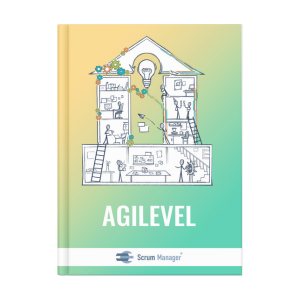
AgiLevel
Core curriculum, 75 SPs
Includes advanced theory to extend agility throughout the entire organization.
Presents the knowledge necessary to guide agility improvement processes in the company: cultural paradigms and differentiated analysis of the cultural and operational dimensions of organizations.
The curriculum develops each of these dimensions, showing the practices and values that form the agile personality pattern of the organization. You learn to identify the strengths and weaknesses of agility in the company in an objective and structured way.

Agile Bedrock
Core curriculum, 150 SPs
Covers agile management of knowledge teams in the era of intelligent assistance (AI).
Presents the firm substrate — the bedrock — of foundations and professional criteria from which each team builds and rebuilds its own agility as the context changes. Rather than prescribing a single framework, it offers an inventory of knowledge faithful to Scrum Manager's agnostic stance, so each professional can develop their own judgment.
Specialization and extension
Approved courses that extend the core training with specialization in specific areas of agile management: management, people management, marketing, programming, etc.
Open each credential to find the centres offering certified training on that topic.
Agile Leadership
Governance in agile organizations (management or coaching of people, teams or talent).
Includes, among others, activities on Corporate Well-being, People & Culture, Management, OKRs and Lean Change Management.
Agile Programming
Agile development and maintenance of ICT systems.
Includes, among others, activities on Agile Testing, DevOps and Cybersecurity.
Agile Scaling
Scaling agility at the enterprise level.
Includes, among others, activities on Nexus and SAFe.
Professional skills
Abilities for professional performance.
The training of these skills is part of the curriculum of some training courses and of the training and assessment platform Skill Arena.
- Agile Inception: validates the ability to resolve alignment before any code is written: defining the problem, who decides and what success means, turning fuzzy intentions into verifiable agreements, and sizing risk and effort with the uncertainty in plain sight (drawing on AI without handing it the framing).
- Agile Leadership - Decision Architecture: confirms the ability to design how decisions flow through an agile team: who decides, with what information and how fast. Classifying decisions by reversibility, assigning explicit decision rights (intent, DACI, decision records) and bringing AI into the flow without giving up human judgment.
-
Communication and conflict management:
recognizes the ability to diagnose a team's communication failures and act at the right level, classify conflict by type and stage of escalation, and apply established frameworks (Watzlawick, Edmondson, Thomas-Kilmann, Fisher-Ury, Rosenberg, Glasl), choosing the tool each situation calls for.
- Design Thinking: certifies the ability to tackle ill-defined problems from people's real experience: turning observation into understanding, reframing the problem before solving it, and alternating divergence and convergence until reaching prototypes you can put in front of someone — with AI supporting synthesis without replacing direct contact with the person who has the problem.
- Discovery and validation with customers: validates the ability to lead unbiased research through interviews and qualitative synthesis, identify real problems (JTBD) and prioritize risks, design learning-focused MVPs with success metrics, and decide with judgment whether to iterate, pivot or persevere.
- Harness Engineering: confirms the ability to apply Harness Engineering when delegating tasks to AI agents: designing, measuring and iterating the guardrails and sensors that wrap the model and act as operational controls — not recommendations it can ignore — ensuring a reliable deliverable, a verifiable process and human judgment over the result.
- AI applied to agile working: recognizes the ability to integrate AI across the agile development cycle, from user stories to testing and code review: designing effective prompts, validating responses, and applying good practice in ethics, privacy, data and security.
- Agile product operating model: certifies an understanding of the product operating model: the decisions about structure, funding, governance, metrics and culture with which an organization builds and runs products continuously, rather than managing them as a succession of projects.
- OKRs and product strategy: validates the ability to turn product vision into measurable outcomes, prioritizing impact over output: writing precise Key Results without prescribing the solution, working with leading metrics and the quarterly cycle, and aligning stakeholders to decide on evidence and avoid the feature factory.
- Scrum in teams with AI: confirms the ability to lead agility in the face of generative AI, shifting the focus from technical engineering to strategic product management: prioritizing real value with Spec-Driven Development (SDD), reshaping traditional roles into AI Product Managers and Product Builders, and sustaining technical and ethical quality in high-throughput workflows.
- SDD in agile teams: recognizes the ability to apply Spec-Driven Development (SDD) in agile teams with generative AI: producing and managing specs that serve as the operational artifact for orchestrating agents, with a four-phase flow and approval gates that ensure quality, architectural coherence and traceability of the generated software.
- User Stories: certifies practical competence with user stories and the rest of the Product Backlog: deciding how much to write and how much to talk through, judging their quality, turning intent into testable rules and examples, and splitting them without losing value (including when AI drafts, reviews or implements).